Shoulda, Coulda, Woulda
April 21, 2026
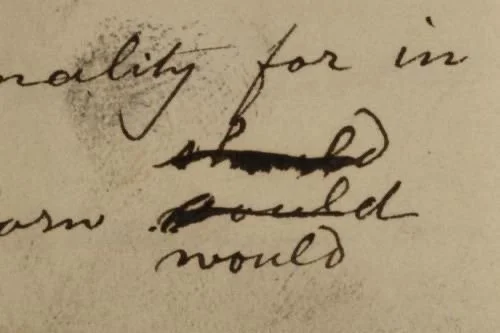
Writer: Brooke Lippman
Editors: Jordana Ingber & Ava Malkin
Photo: Pinterest
I couldn’t help but wonder: what if regret isn’t inherently harmful–but rather, it’s the way we choose to talk about it?
“Shoulda, coulda, woulda.” It’s the kind of phrase that slips out easily, almost instinctively, like a reflex after something doesn’t go the way you hoped. A bad exam, a conversation that felt slightly off, a moment that lingers longer than it should. It sounds light, almost dismissive. But beneath its casual tone is a much heavier implication. Those three words don’t simply reflect the past; they reconstruct it. They suggest that there was a singular, correct path–a version of events in which we made the “right” choice–and that we somehow failed to follow it.
A few weeks ago, I walked out of a prelim knowing I could have done better. Not in a vague way, but in a painfully specific one. I could picture the questions I rushed, the concepts I half understood, the hours I should have spent studying. And almost immediately, it spiraled: I should have started earlier. I could have gone to office hours. I would have done better if I had actually tried. Suddenly, it wasn’t about the test anymore—it was about me. My discipline, my priorities, my ability to handle things. It’s strange how easily one moment can expand like that–how it stops being about what happened and starts becoming a narrative about who you are.
And that’s when it hit me—“shoulda, coulda, woulda” isn’t reflective. It’s accusatory. It convinces you there was one perfect version of that moment, and somehow you just missed it. But the version of me who took that exam didn’t have the clarity I have now. She was tired, maybe a bit overwhelmed, and doing her best with what she had. She made decisions in real time, without the benefit of hindsight, without the ability to pause and revise. And still, I found myself evaluating her as if she had been handed some answer key and chose to ignore it.
We do this all the time, and not just with academics. It’s the conversation you replay on the walk home, thinking of the one thing you didn’t say. The text you draft and delete three times before sending something safe. The club you almost applied for, the person you almost asked to get coffee, the moment that felt small until it didn’t. Each time, the same quiet rewrite: there was a better version of this, and you somehow missed it.
What gets lost is how uncertain those moments actually felt while they were happening. Nothing announces itself as the moment you’ll revisit later, and there’s no signal that this is the version you’ll wish you could revise. There is only the immediacy of it—you responding, choosing, moving forward with partial information and limited clarity. It is only afterward that everything sharpens.
The hesitation disappears, and the alternatives fall into line. In this sense, it becomes easy to isolate the exact point–like an “X” on a map drawn after the journey is already over–where things could have gone differently, as if the right answer had been there all along, waiting. But that version of clarity belongs to hindsight, not the moment itself.
In the moment, what existed was ambiguity. You made a decision without knowing how it would unfold. You acted as the version of yourself that existed then—one shaped by fatigue, uncertainty, and incomplete understanding—not the version who now has the distance and hindsight to make sense of it. Yet, it is within human nature to return to those moments with a language that suggests otherwise–one that quietly insists we should have known, could have done more, would have chosen differently.
There is something deceptively comforting in that framing. It suggests that life is, at some level, optimizable—that better outcomes are simply the result of better decisions. But it also carries a consequence: it turns every alternative into a mistake, and every version of yourself into someone who fell short of what was possible.
What I’ve started to notice instead is something quieter. After that exam, beneath all the self-criticism, there was something else: an awareness of what didn’t work and how I should approach the exam next time–not as a punishment, but as a kind of enlightenment. It doesn’t arrive immediately, and it doesn’t take the form of a clean, definitive sentence. It shows up later, not as a correction, but as a kind of recognition: that I rushed because I didn’t fully grasp the material, that I avoided asking for help because I didn’t yet know how to articulate what I didn’t understand, that I misjudged what I was capable of holding at once.
Maybe that’s the shift–learning to recognize the difference between judgment and understanding. Between telling yourself you should have known better and realizing that now, you do.
In a place like college, where everything can feel both immediate and defining, it’s easy to let small moments take on too much meaning. To let one decision stand in for something much larger. But maybe those moments aren’t meant to define us in that way. Maybe they are simply part of how we begin to understand ourselves—slowly, imperfectly, over time.
I still catch myself thinking in “shoulda, coulda, woulda.” It hasn’t disappeared. But I’ve started to pause, just slightly, before letting it settle in. To ask whether I’m actually reflecting, or just rewriting.
Because maybe the point isn’t to get everything right the first time. Maybe it’s to stop treating the past like something that needed fixing, and start seeing it as something that was always in motion—something that was never meant to be perfect, only lived.